Part 1
Understanding Fresh-Milled Flour
1. Why Mill Your Own Flour?
Fresh-milled flour is made by grinding whole grain shortly before baking. When the whole kernel is milled and the flour is not sifted, the bran, germ, and endosperm are all present. That means the flour includes the grain’s fiber, natural oils, vitamins, minerals, plant compounds, flavor, and aroma.
The amount of each nutrient varies with the grain and how it is grown, stored, and milled. Fresh milling preserves the whole-grain parts; it does not add nutrients or guarantee a particular health result.
A closer look
Conventional White Flour on Grocery Store Shelves
Picking up a bag of bread flour or all-purpose flour is convenient, but refined white flour is different from whole-grain flour. A wheat kernel has three main parts:
Bran
The outer layers of the kernel contain fiber and many of the grain’s minerals, B vitamins, and plant compounds.
Germ
The embryo of the seed contains natural oils, vitamin E, B vitamins, and other nutrients.
Endosperm
The largest part of the kernel is mostly starch, with protein that contributes to dough structure.
To make refined white flour, milling removes most of the bran and germ and keeps primarily the endosperm. Those outer parts contain oils that can shorten flour’s storage life, so removing them helps flour keep longer. Enriched flour may then have specific vitamins and minerals added back.
What changes
What Is Lost?
When the bran and germ are removed, the flour loses much of the grain’s naturally occurring:
- Dietary fiber
- Natural oils
- Vitamin E and B vitamins
- Minerals such as magnesium, zinc, phosphorus, potassium, manganese, and selenium
- Antioxidants and other plant compounds
The refined flour that remains is made mostly of starch and protein. Its structure can work well for baking, but it is no longer the complete grain.
A label you may see
What About “Enriched” Flour?
Many refined flours are labeled enriched. After the bran and germ are removed, manufacturers add back a specified group of nutrients. In the United States, enriched flour includes thiamin (vitamin B₁), riboflavin (B₂), niacin (B₃), iron, and folic acid.
Enrichment helps restore those specific nutrients, but it does not put the bran and germ back into the flour or restore all of the grain’s fiber, natural oils, and other plant compounds.
Why fresh-milled flour is different
The Whole Kernel Stays in the Flour
When you mill the whole grain and use the flour without sifting, the bran, germ, and endosperm remain together. Milling shortly before baking gives you the fresh aroma and flavor of the grain and keeps the whole-grain parts in your flour.
Fresh milling doesn’t add nutrients to the grain—it lets you use the whole grain as it is.
Lesson 2
Ancient, Heritage & Modern Grains: Not All Wheat Is the Same
Grains have different histories, growing traits, flavors, and baking qualities. The words ancient, heritage, and modern are helpful labels, but they are not rigid scientific categories with one universal cutoff. Here is how I use them when I talk about the grains I bake with.
Ancient grains
Older grain types and species
Often used for grains and wheats with long histories of cultivation and comparatively little change from older forms. That does not mean people never selected or cultivated them over time.
Examples: einkorn, emmer, spelt, and Khorasan wheat. “Kamut®” is a brand name associated with Khorasan wheat.
Heritage wheat
Traditional varieties with a story
Older varieties and landraces valued for their history, flavor, regional importance, and genetic diversity. The exact meaning of “heritage” can vary by grower and source.
Examples: Turkey Red, Red Fife, Rouge de Bordeaux, and White Sonora.
Modern wheat
Varieties shaped by contemporary breeding
Conventional breeding has developed modern varieties for goals such as reliable yields, disease resistance, lodging resistance, and consistent milling or baking performance.
Examples: hard white, hard red, and soft white wheat. Hard white wheat has a mild flavor and can be a friendly place to begin with bread.
Other traditional grains: rye, barley, millet, sorghum, and teff have their own histories and uses. “Ancient,” “heritage,” and “modern” can be applied differently across sources, and these grains are not all types of wheat.
My favorite heritage wheat
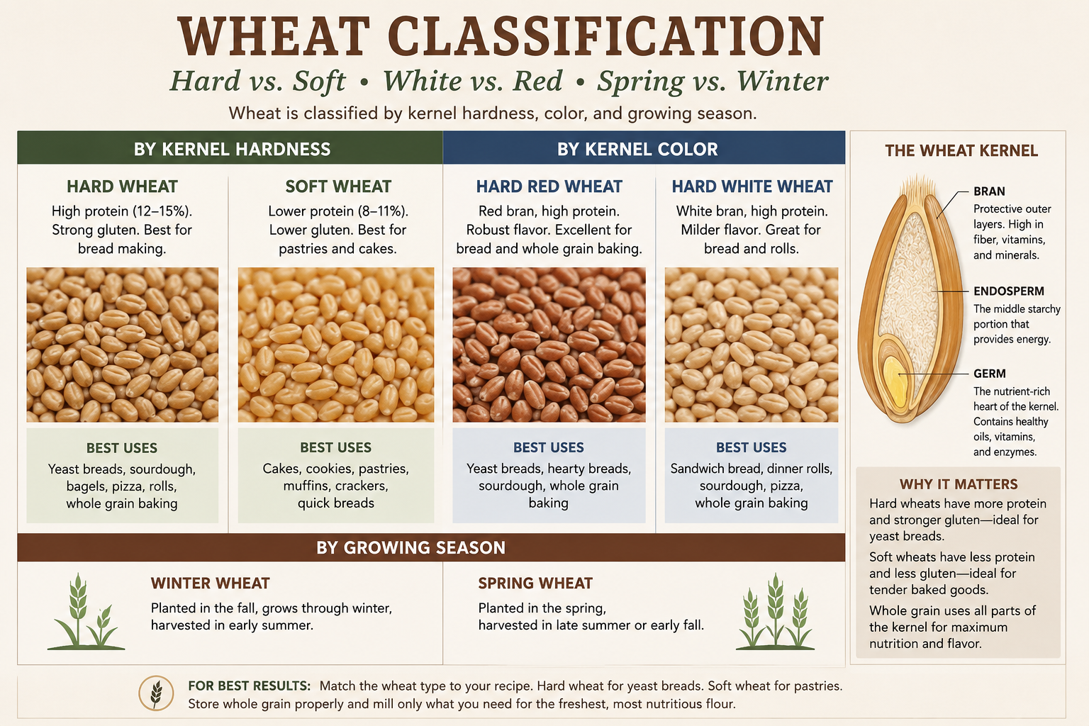
Turkey Red
Turkey Red is a heritage hard red winter wheat associated with Mennonite immigrants from the region of present-day Ukraine and their settlement on the Great Plains in the 1870s. Its history is connected to the Black Sea region, and it carries the legacy of older wheat populations.
I love its rich, nutty flavor and beautiful whole-grain color. It works well in my sandwich bread, sourdough, rolls, and pizza dough.
A note on the history: The familiar account says Mennonite families brought Turkey Red seed to Kansas in the 1870s. Historians have noted that the exact route and timing are more complicated: evidence for seed carried by immigrant families is limited, while larger seed imports and promotion are documented later in the 1880s. The sources below show both accounts.
Why I bake with them
Heritage & Ancient Grains
I choose to bake with heritage and ancient grains because I appreciate using grains connected to the food and farming traditions of generations before us. Each one brings its own history, flavor, and baking character to a loaf. I enjoy learning what each grain contributes and how it connects me to our agricultural heritage.
Lesson 3
Understanding Wheat Classifications
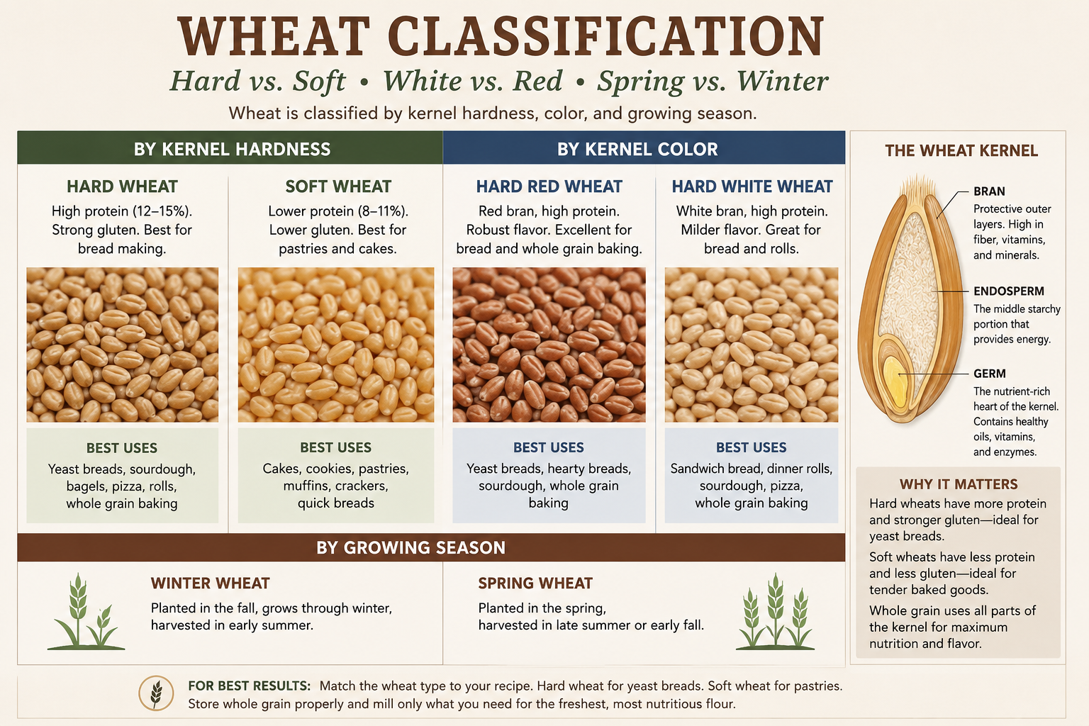
Wheat varieties are often described using three characteristics: hardness, kernel color, and growing season. These labels help you understand a grain’s baking qualities and when it grows.
Hard vs. Soft Wheat
| Type | Higher protein? | Best uses |
|---|---|---|
| Hard wheat | Yes | Bread, pizza dough, rolls, bagels, sourdough |
| Soft wheat | No | Cakes, cookies, muffins, biscuits, pancakes, pastries |
Red vs. White Wheat
| Type | Flavor | Best for |
|---|---|---|
| Red wheat | Rich, hearty, traditional wheat flavor | Bread, artisan loaves, pizza |
| White wheat | Mild, slightly sweeter | Sandwich bread, baked goods, and recipes for those new to whole grains |
Spring vs. Winter Wheat
These terms describe when wheat is planted, not how it tastes or how well it bakes.
- Winter wheat is planted in the fall, survives the winter, and is harvested the following summer.
- Spring wheat is planted in the spring and harvested later that same year.
- Many excellent bread wheats are winter wheats, including Turkey Red.
How the Grains in This Guide Are Classified
This table is a practical baking guide. Some details vary among cultivars and growing regions, and not every grain listed is a type of wheat.
| Grain | Hard / soft | Red / white / other | Spring / winter | Classification | Best uses |
|---|---|---|---|---|---|
| Turkey Red | Hard | Red | Winter | Heritage wheat | Sandwich bread, sourdough, pizza |
| Hard white | Hard | White | Usually winter* | Modern wheat | Everyday bread |
| White Sonora | Soft | White | Spring | Heritage wheat | Cakes, cookies, pastries |
| Spelt | Hard† | Not usually grouped as red or white bread wheat | Winter | Ancient grain | Bread, cookies, muffins |
| Einkorn | Soft‡ | Not usually grouped as red or white bread wheat | Spring or winter | Ancient grain | Cakes, cookies, blended breads |
| Emmer (farro) | Hard | Not usually grouped as red or white bread wheat | Winter | Ancient grain | Rustic breads, pasta, blending |
| Khorasan | Hard | Amber | Spring | Ancient grain | Bread, pasta, pancakes |
| Rye | Moderate | Not applicable | Winter | Traditional grain | Rye bread, sourdough, blending |
| Barley | Soft | Not applicable | Spring or winter | Ancient / traditional grain | Blending into breads, soups |
* Modern hard white wheat includes both winter and spring varieties; winter types are common among home-baking grains. † Spelt is classed as hard by kernel texture or protein level, but its gluten is more extensible and less elastic than modern bread wheat, often producing a softer, more tender dough. ‡ Einkorn can have relatively high protein while forming weak gluten, so it can behave more like a soft wheat in baking.
Lesson 4
Building Your First Grain Pantry
You do not need to buy every grain at once. One of the biggest misconceptions about fresh-milled baking is that you need a pantry full of different grains before you can begin. You do not.
Start with a few versatile grains, become comfortable baking with them, and gradually expand your collection. Each grain has its own flavor, texture, and baking characteristics. Learning one grain at a time helps you understand what it contributes to your bread.
My Recommended Starter Grains
#1
Turkey Red
Heritage · hard · red · winter wheat
My favorite wheat to bake with. It has a rich, robust wheat flavor, excellent baking strength, and makes beautiful sandwich bread, sourdough, dinner rolls, and pizza dough. If I could keep only one bread wheat in my pantry, it would be Turkey Red.
Best uses
- Sandwich bread
- Sourdough
- Dinner rolls
- Pizza dough
- Artisan loaves
#2
Spelt
Ancient grain
Spelt has a mild, nutty flavor and creates an incredibly tender crumb. I love adding it to bread recipes for softness, and it also works beautifully in cookies, muffins, pancakes, and quick breads. Because spelt develops gluten differently from modern wheat, it benefits from gentle handling and adequate hydration.
Best uses
- Sandwich bread blends
- Cookies
- Muffins
- Pancakes
- Quick breads
#3
Khorasan
Ancient · hard · amber wheat
Khorasan is an ancient grain known for its large golden kernels and rich, buttery, nutty flavor. It produces a soft, tender crumb and generally has good baking strength, though it benefits from gentler mixing than modern bread wheats. It adds flavor to yeast breads and sourdough.
Best uses
- Bread
- Pizza dough
- Pancakes and waffles
- Cookies
- Fresh pasta
#4
White Sonora
Heritage · soft · white · spring wheat
White Sonora is one of the oldest wheat varieties grown in North America. As a soft wheat, it makes exceptionally tender baked goods with a delicate, slightly sweet flavor.
Best uses
- Cakes
- Cookies
- Muffins
- Biscuits
- Pancakes and pastries
#5
Hard White Wheat
Modern · hard · white wheat
Hard white wheat has a mild flavor similar to the whole-wheat flour many people know from grocery stores. It is an excellent everyday bread wheat and a comfortable starting point when transitioning to whole grains.
Best uses
- Sandwich bread
- Dinner rolls
- Hamburger buns
- Everyday baking
Grains to Explore Later
Once you are comfortable with your starter grains, experiment with one new grain at a time. Each offers its own flavor, texture, and nutritional profile.
- Emmer (farro) — An ancient grain with a hearty, earthy flavor that adds depth to rustic breads. Browse my grain picks ↗
- Rye — Adds complexity, moisture, and excellent sourdough flavor. Browse my grain picks ↗
- Barley — A mild, slightly sweet grain that works well blended into bread recipes. Browse my grain picks ↗
Amazon affiliate disclosure: As an Amazon Associate, I earn from qualifying purchases. I may receive a commission if you shop through these links, at no additional cost to you.