
First, what is it?
Starch that makes it farther through digestion
Most starch is broken down in the small intestine. Resistant starch is the part that resists some of that digestion and travels on to the large intestine, where gut bacteria ferment it.
That fermentation makes substances called short-chain fatty acids, including butyrate. Scientists are studying what that means for the gut. It’s an interesting part of food science, but it doesn’t mean one food will fix everyone’s digestion.
Why cooling matters
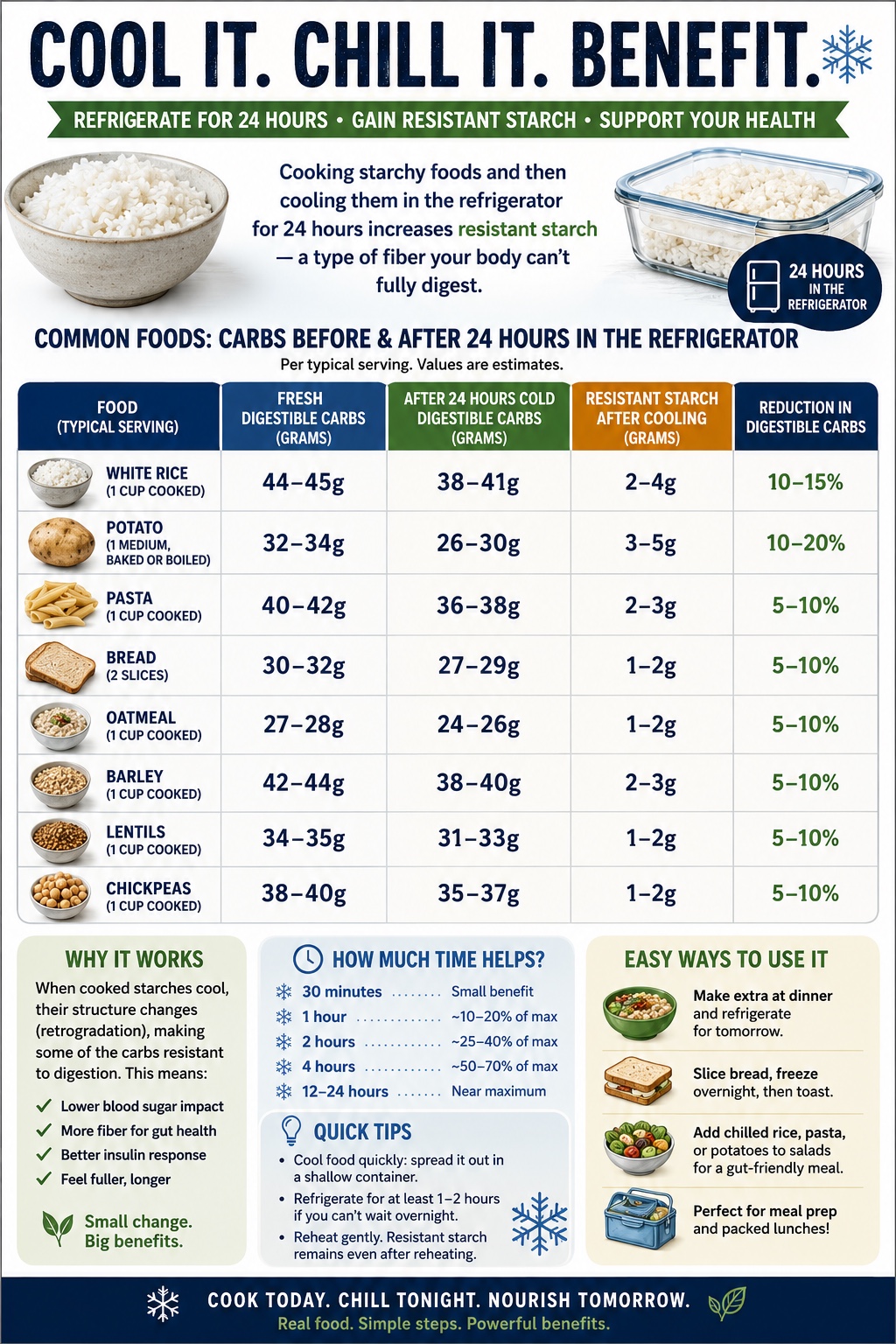
Cook it, cool it, and some starch changes
The part that clicked for me is this: cooking softens the starch in foods like rice, potatoes, and pasta. As the food cools, some starch molecules line up more tightly. Scientists call that retrogradation. Digestive enzymes may have a harder time breaking down some of that re-formed starch.
That cooled form is called resistant starch type 3, or RS3. Some of it can remain even if you reheat the food. The amount depends on the food and how it was cooked, cooled, stored, and reheated—so there isn’t one percentage that applies to everything.
What might that mean?
Blood sugar, gut health, and what we still don’t know
Blood sugar
It may make a difference
Some small studies found a lower after-meal blood-sugar response with certain cooled-rice preparations. Results aren’t the same for every rice or study, and they don’t predict exactly how one person will respond.
Gut
Gut bacteria use it
Resistant starch is fermented in the large intestine. That’s why researchers are interested in it. People can feel differently when foods are fermented in the gut.
Carbohydrates
It doesn’t cancel them
Cooling doesn’t turn rice, potatoes, or pasta into carb-free foods. Don’t subtract a guessed number of carbs just because food was chilled.
Real life
It’s one small detail
Grain variety, cooking method, the rest of the meal, and individual digestion all matter. Resistant starch is one piece of a much bigger picture.
A note for anyone using insulin: In one small study with people who have type 1 diabetes, cooled rice changed blood-sugar response. The researchers also reported more low-blood-sugar episodes while participants used their usual insulin dose. Don’t change your care based on a food-prep tip—follow your diabetes team’s advice.
And what about bread?
Freeze a loaf for later—and maybe get a little RS3 along the way
Fresh bread is lovely, but homemade loaves don’t stay at their best forever. Freezing is an easy way to save a loaf for later and cut down on waste. It may have a resistant-starch bonus, too.
Some starch naturally reorganizes as bread cools after baking. That cooling can form RS3. A freeze-and-thaw cycle may also affect the starch, and small human studies have found a lower blood-sugar response after people ate frozen-and-thawed bread than after fresh bread. One small study found an additional difference when the frozen bread was toasted. These studies were limited, mostly tested white bread or wheat rolls, and don’t tell us exactly how much resistant starch is in every loaf—or how any one person will respond.
How I’d freeze a homemade loaf
Let it cool completely. Slicing and wrapping a warm loaf can trap moisture.
Slice it if that’s handy. Then you can take out a few slices without thawing the whole loaf.
Wrap it well. Use a freezer bag or airtight wrapping, press out extra air, and label it with the date.
Thaw or toast. Thaw slices in their wrapping, or toast slices straight from frozen. A whole loaf can thaw, still wrapped, at room temperature.
For best quality, the University of Nebraska–Lincoln’s home-storage chart suggests using homemade bread within about three months in a 0°F freezer. That’s a quality guideline, not a claim that bread suddenly becomes unsafe after that point. Good wrapping helps protect its flavor and texture.
A small study of 10 healthy volunteers compared fresh, frozen-and-thawed, and toasted white bread: Burton and Lightowler, European Journal of Clinical Nutrition. A wheat-roll study also found differences after frozen storage, while noting that more work was needed to measure the resistant-starch content directly: Borczak and colleagues. For freezer quality guidance, see University of Nebraska–Lincoln Food Storage.
A simple kitchen approach
If you want to try it, keep it simple
You don’t need a special recipe, oil, or gadget. Cook rice, potatoes, or pasta the way you normally do. If you have leftovers, cool and store them safely.
Cook as usual. There is no special cooking ratio that guarantees a certain amount of resistant starch.
Cool promptly. Transfer leftovers to shallow containers and refrigerate within 2 hours—within 1 hour if it’s hotter than 90°F.
Chill if that fits your plans. Research often tests food chilled overnight, but home cooling can’t promise an exact resistant-starch amount.
Eat cold or reheat. If reheating, bring leftovers to 165°F and return what remains to the refrigerator promptly.
For the storage and reheating details, see the USDA’s leftover guidance.
A little more, if you’re curious
You may see RS1 through RS5
Scientists use these labels for different forms of resistant starch. You don’t have to memorize them. For the cook-and-cool idea, the one to know is RS3.
RS1
Starch tucked inside intact food structure, like whole grains and legumes.
RS2
Some uncooked starch granules, such as those in green bananas and raw potato starch.
RS3
Some starch that firms up again after cooked food cools.
RS4 + RS5
Forms created by food processing or by starch interacting with fat.
Want to read more? Here’s a plain-language review of resistant starch research, a rice study in healthy adults, and a rice study in people with type 1 diabetes.
This is general information, not personal medical advice. Research is still developing, and individual experiences can differ.